Excavator Weight, Size & Dimensions Chart
Use this excavator size comparison chart to compare operating weight in tons, transport width, digging depth and bucket capacity before choosing a machine class. A standard 20-ton excavator commonly falls within the 20–25 ton operating-weight class and is roughly 2.8–3.0 metres wide, but the exact dimensions change with the model, undercarriage and attachment. Confirm the serial-number configuration and measure the exact machine before transport.
Turn specifications into a buying decision
Get a current machine shortlist, evidence and a port quote
Tell us your target weight class, application and destination port. The HMP team will match the request to current product pages, confirm which photos or inspection records are available, and return equipment-only, FOB, CFR or CIF terms in writing.
01
Match the class
Weight, width and job application.
02
Verify the unit
Current photos, meter and evidence.
03
Quote the route
FOB, CFR or CIF to your port.
Get CIF/FOB Quote for Excavator specs shortlist
Pre-filled wholesale inquiry for model SPECS-PAGE.
Quick Reference: Excavator Specifications Overview
For quick procurement decisions, here are the core definitions and metrics used in our excavators specs and charts:
Excavator Weight (Operating Weight)
The total weight of the machine ready for work (including a standard boom, stick, bucket, full fluids, and a 75kg operator). This dictates transport requirements and ground bearing pressure.
Excavator Width (Transport Width)
The total outside-to-outside measurement of the tracks. Machines over 2.5 meters (8.2 feet) typically require special wide-load transport permits depending on regional highway regulations.
Max Dig Depth
The maximum vertical reach of the bucket below ground level. Dictated by the boom and arm (stick) length combination.
Classifications
Categorized into Mini (< 10 Tons), Medium (10 - 30 Tons), and Large (30+ Tons) to match specific applications from urban landscaping to heavy quarrying.
Explore Excavator Specs by Brand
Navigate directly to our dedicated manufacturer hubs to view the specific excavator sizes chart, models, and technical data for the world's leading heavy equipment brands.
Renowned for unparalleled durability and advanced ACERT engine technology. Explore specs for the legendary 320, heavy-duty 336, and versatile Next Gen GC series.
Industry leaders in hydraulic efficiency and intelligent machine control. Access detailed charts for the PC200, PC300, and PC400 series.
Top-tier hydraulic excavators favored in mining and massive earthmoving. Review the ZX (Zaxis) series specifications.
Exceptional fuel efficiency and operator comfort. Discover the operating weight and dimensions of the EC series excavators.
The global leader in compact and mini excavators. Perfect for urban utilities and landscaping. View specs for the KX and U series.
High performance and excellent ROI. Access technical dimensions and charts for the DX and DH crawler excavators.
Robust construction equipment featuring the HX and R (Robex) series, balancing power with precision electronics.
Specialists in fuel-efficient, ultra-low noise excavators. View the SK series dimensional and weight charts.
Rapidly growing global footprint with robust structural designs. Check the SY series for cost-effective heavy machinery solutions.
Excavator Weight Classifications
The most critical metric when evaluating excavator specs is the operating weight. The excavator weight determines not only the digging force and lifting capacity of the machine but also the logistical realities of transporting it to the job site.
Mini and Compact Excavators
(0.5 to 10 Tons)
Ideal for precision work in confined spaces. An excavator sizes chart for this category typically highlights zero tail swing (ZTS) designs, allowing the structure to rotate within the track width.
Medium / Standard Excavators
(10 to 30 Tons)
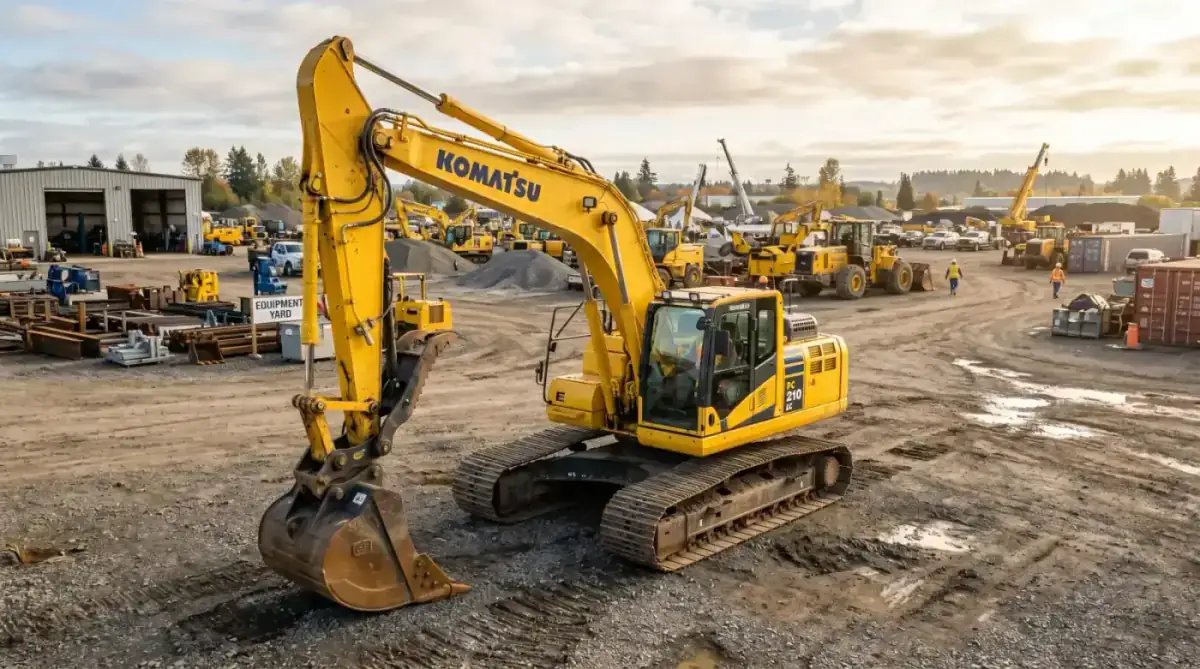
This is the bread and butter of construction. Machines in the 20-ton range (Caterpillar 320, Komatsu PC200) offer the perfect balance of power, reach, and transportability.
Large / Heavy Excavators
(30+ Tons)
Titans designed for maximum earthmoving, ranging up to 100+ ton mining shovels. Their specs feature High Flow auxiliary hydraulics for rock breakers.
Excavator Width and Transport Logistics
One of the most frequently searched parameters on any excavator sizes chart is the overall track width. Understanding excavator width is absolutely vital for regulatory compliance and safety during transportation.
LC (Long Crawler) configurations often correlation with wider gauges for better stability but increase transport complexity.
RoRo vs Container: Widths exceeding 2.6m typically require specialized Flat Rack or RoRo maritime logistics.
How to Read Comprehensive Excavators Specs and Charts
Learn to interpret professional technical matrices to maximize project ROI.
| Specification Name | Definition & Industry Importance |
|---|---|
| Operating Weight | The actual working weight of the machine. It dictates the machine's inertia, lifting stability over the side, and transport trailer capacity. Do not confuse this with 'Shipping Weight' which excludes fluids and the bucket. |
| Net Engine Power (HP/kW) | The power available at the flywheel after deducting losses from the fan, alternator, and water pump. Higher HP allows for faster hydraulic cycle times under heavy loads. Look for Tier 4 Final or Stage V emissions compliance. |
| Maximum Digging Depth | Crucial for utilities. For deep foundation (>5.0m) or oil/gas pipeline trenching, ensure the boom and stick geometry can reach the required invert elevation without benching down. |
| Bucket Capacity (Heaped) | Measured in cubic meters (m³) or cubic yards (yd³). 'Heaped' assumes the material is piled above the bucket edges. This metric, combined with cycle times, determines your hourly production rate in dirt removal. |
| Breakout Force (ISO) | The absolute maximum force exerted by the bucket cylinder at the cutting edge. High breakout force is mandatory for quarrying, demolition, and ripping through hardpan clay or shale. |
| Tail Swing Radius | The distance from the center of rotation to the furthest rear edge of the counterweight. Standard tail swing offers maximum lifting stability, while Zero Tail Swing (ZTS) prevents rear-end collisions in highway embankment & road grading work. |
General Excavator Sizes Chart (Reference Guide)
| Machine Class | Weight Range | Average Engine HP | Avg. Excavator Width | Typical Dig Depth | Bucket Range (m³) |
|---|---|---|---|---|---|
| Micro / Ultra-Compact | 0.8 - 2.0 Tons | 10 - 20 HP | 0.7m - 1.0m | 1.5m - 2.2m | 0.02 - 0.05 |
| Mini | 3.0 - 6.0 Tons | 25 - 50 HP | 1.5m - 1.9m | 3.0m - 4.0m | 0.10 - 0.25 |
| Midi / Compact | 7.0 - 10.0 Tons | 55 - 75 HP | 2.1m - 2.3m | 4.1m - 4.6m | 0.25 - 0.45 |
| Standard Medium | 12.0 - 16.0 Tons | 90 - 120 HP | 2.5m - 2.6m | 5.5m - 6.0m | 0.50 - 0.70 |
| Full-Size Standard | 20.0 - 25.0 Tons | 140 - 170 HP | 2.8m - 3.0m | 6.5m - 7.0m | 0.80 - 1.20 |
| Heavy Duty | 30.0 - 40.0 Tons | 250 - 320 HP | 3.2m - 3.4m | 7.2m - 8.0m | 1.40 - 1.90 |
| Mass Excavation | 45.0 - 80.0+ Tons | 350 - 550+ HP | 3.5m+ (Often Dismantled) | 7.5m - 9.0m | 2.00 - 4.50+ |
Advanced Technical Specifications Explained
System Pressure & Flow
Modern specs track Hydraulic Maximum Flow Rate (L/min) which dictates speed. High pressure determines the absolute force applied during extraction.
Cycle Times
The speed of boom up/down and swing rotation is critical. A1 units maintain factory cycle time specs, maximizing hourly earthmoving production.
Machine Control & GPS
Some current machines may include 2D/3D grade-control readiness, but configuration must be confirmed for the exact unit. Ask for the machine-specific control-system evidence before treating GPS capability as included.
Frequently Asked Questions
What is the industry standard excavator weight for construction?
The 20-to-21 ton class (for example, CAT 320 or Komatsu PC200 families) is a common construction reference because it balances digging reach, production and transport planning. Confirm the exact model and configuration before buying.
How does track width affect transport logistics?
Global highway regulations typically require permits for loads over 2.6 meters. Standard 20T excavators often exceed this, requiring careful logistics planning.
Operating Weight vs Shipping Weight?
Operating weight includes a standard bucket, full fuel, and an operator. Shipping weight is the bare factory weight. Use operating weight for ground pressure calculations.
Source Your Machine with Verified Specs
Compare current Caterpillar, Komatsu and Sany listings with the available engineering data, unit-specific evidence and destination-port support.