Any warranty or remedy applies only when it is written in the signed sales contract for the selected unit, including covered parts, duration, exclusions, and claim procedure.
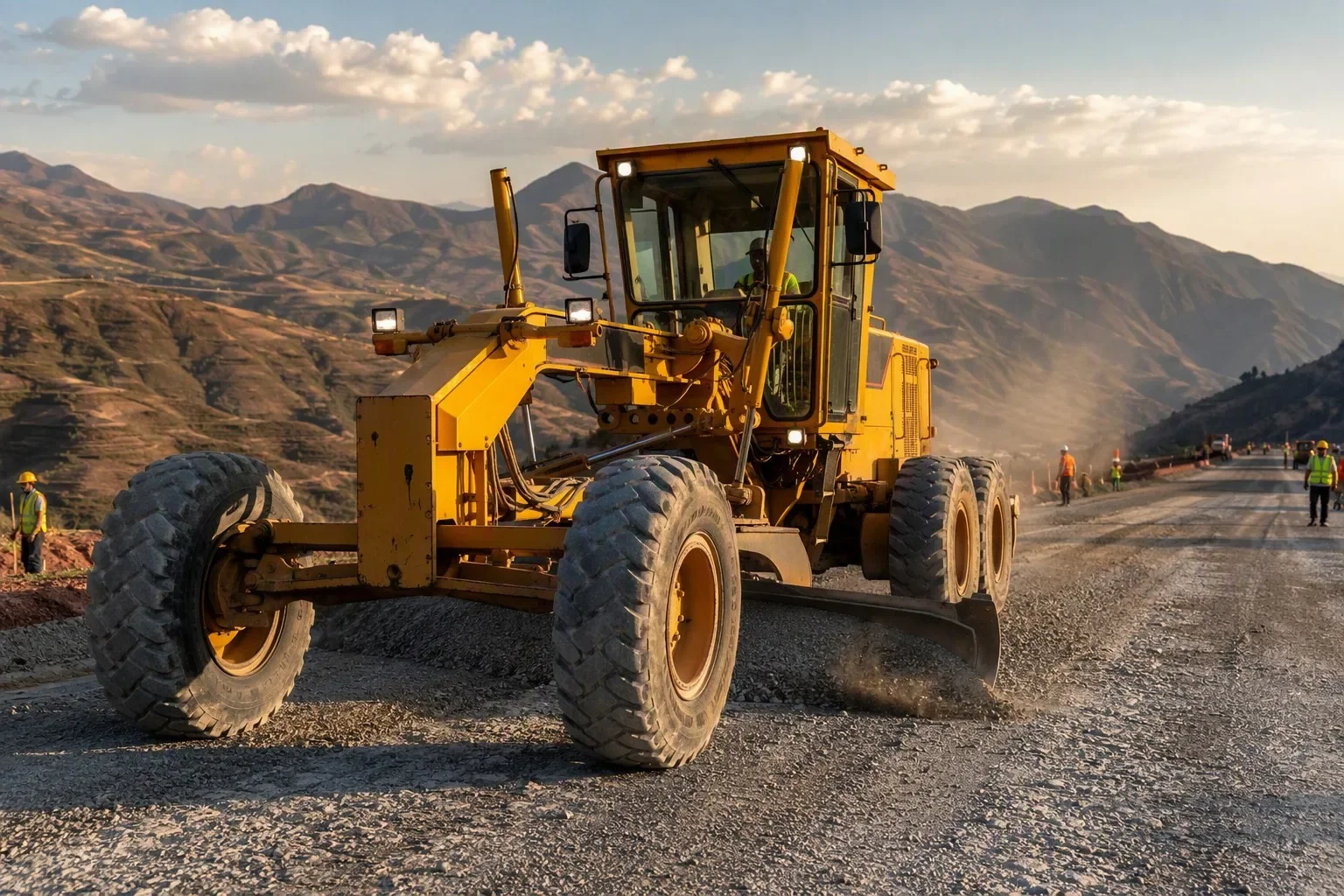
The global sourcing sector for the used motor grader — the long-articulated, blade-carrying machine that finishes every gravel road, airport runway, and mining haul road on the planet — has entered its strongest sourcing cycle in fifteen years. As new-machine lead times from Caterpillar, Komatsu, and Volvo stretch to 12–16 months and list prices climb past a current written quote for a 140-class motor grader, contractors in emerging markets are moving decisively toward certified pre-owned units sourced directly from Chinese export yards.
This 2026 sourcing sector intelligence report from HEAVY MACHINERY PRO (HMP), a Shanghai used-machinery export supplier and export yard for used construction machinery, breaks down the demand drivers, model economics, inspection framework, regional shipping logistics, and total-cost-of-ownership analysis that any global buyer needs before placing a purchase order. Every price and specification quoted is drawn from HMP’s live August 2026 inventory and internal commercial records that should be independently verified.
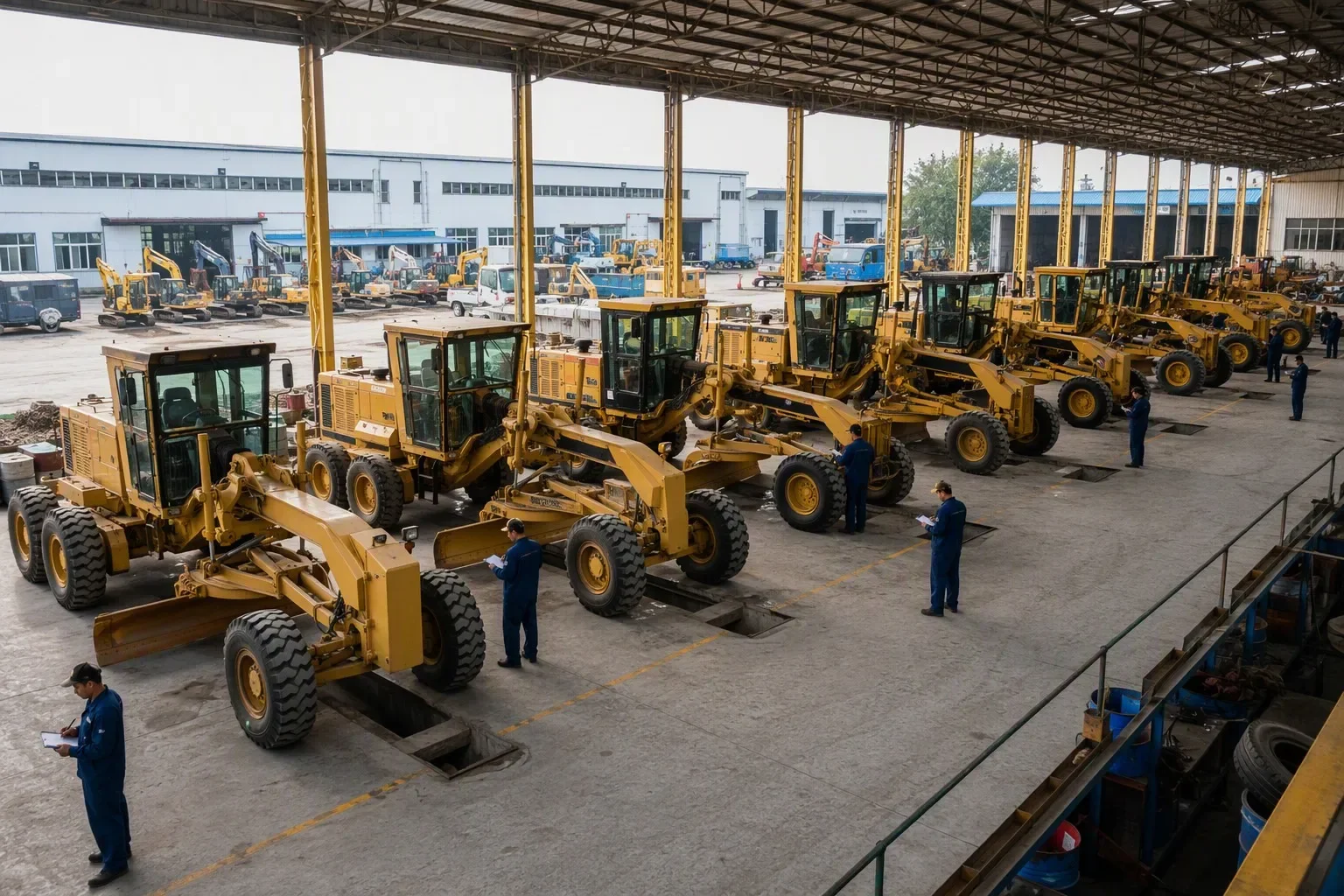
1. Why Global Demand for Used Motor Graders Is at a 15-Year High
This content compares commonly requested equipment without claiming an independently verified sourcing sector ranking. Buyers should compare the exact units using specifications, condition evidence, service history, local parts support, and written commercial terms.
Force 1 — Africa’s road-density gap: the African Development Bank’s 2026 Continental Infrastructure Outlook estimates that Sub-Saharan Africa still has only 204 kilometres of paved road per one thousand square kilometres of land area, versus a global average of 944. Closing that gap over the next fifteen years will require an estimated forty-two thousand new motor graders across the continent. New Caterpillar and Komatsu supply cannot meet more than a fraction of that demand, so certified used graders from China have become the default sourcing channel for Nigerian, Kenyan, Ghanaian, Tanzanian, and Ethiopian contractors.
Force 2 — Middle Eastern mega-project acceleration: Saudi Arabia’s NEOM, The Line, Qiddiya, and Red Sea Global tourism developments; the United Arab Emirates’ continued Etihad Rail expansion; and Qatar’s post-World Cup transport upgrades collectively require more than five hundred motor graders per year over the 2026–2030 window. Because these projects operate on tight schedules with heavy penalty clauses, subcontractors cannot wait 12–16 months for new-machine delivery and are aggressively securing used units for immediate deployment.
Force 3 — Latin American mining and agricultural expansion: Peru, Chile, Colombia, and Brazil have collectively announced a current written quote billion in new mining and agribusiness investment for 2026–2029. Each mine and each large agricultural estate requires motor graders to maintain unpaved haul roads and access lanes; used CAT 140K and Komatsu GD511 units from Chinese yards land in Callao or Santos at prices 45–a documented unit-specific resultbelow new-machine equivalents.
The combined effect of these three demand vectors is that HMP’s Shanghai yard now moves 20–35 certified used motor graders per month across the six regions above — an increase of roughly a documented unit-specific resultversus our 2023 baseline. Buyers who wait until 2027 or 2028 to acquire units will face significantly higher CIF pricing as this demand curve continues to steepen.
2. Head-to-Head: CAT 140K vs Komatsu GD511 vs XCMG GR215 (2026 Comparison Table)
Global buyers routinely ask which motor grader model represents the best value for their specific application. The answer depends on three variables: the terrain and climate the machine will operate in, the availability of dealer service in the destination country, and the total capital budget. Below is HMP’s field-tested comparison of the three most-requested 14–16 ton used motor graders for 2026:
| Specification | Caterpillar 140K | Komatsu GD511A-1 | XCMG GR215 |
|---|---|---|---|
| Operating Weight | 14,750 kg | 13,750 kg | 15,650 kg |
| Engine | CAT C7 ACERT (7.2 L, Tier 3) | Komatsu SAA6D107E-1 (7.4 L, Tier 3) | Cummins QSB6.7 (6.7 L, Tier 3) |
| Rated Power | 138 kW / 185 hp | 132 kW / 177 hp | 158 kW / 212 hp |
| Moldboard Length | 3.66 m (12 ft) | 3.71 m | 4.27 m (14 ft) |
| Blade Pull Force | 7,850 kgf | 7,600 kgf | 8,400 kgf |
| Blade Down Pressure | 6,900 kgf | 6,700 kgf | 7,200 kgf |
| Articulation Angle | ±25° | ±25° | ±22° |
| Fuel Consumption (grading) | 15–19 L/h | 14–17 L/h | 18–22 L/h |
| Top Travel Speed | 45.6 km/h | 43.9 km/h | 42.0 km/h |
| Used sourcing sector Price (a documented unit-specific result, CIF Lagos) | a current written quote | a current written quote | a current written quote |
| Best For | Highway maintenance, mining haul roads | Desert / high-temperature grading | Budget fleets, agricultural grading |
Any warranty or remedy applies only when it is written in the signed sales contract for the selected unit, including covered parts, duration, exclusions, and claim procedure.
3. Why the Caterpillar 140K Remains the Global Reference Motor Grader
Ask ten contractors in Nairobi, Lagos, Nouakchott, or Lima which motor grader they trust for a five-hundred-kilometer road-maintenance contract, and at least seven will name the Caterpillar 140K. This dominance is not marketing sentiment — it is engineering and dealer-network reality. Caterpillar produced the 140K from 2007 through 2015 as the successor to the legendary 140H, incorporating every proven improvement without adding the emissions complexity of the Tier 4 Final 140M3 that followed. The result is arguably the most reliable, most-loved motor grader ever built.
- CAT C7 ACERT engine: a 7.2 L in-line six-cylinder with proven 20,000+ hour block life, tolerates sub-Saharan African diesel quality that would degrade a Tier 4 machine within months.
- Direct-drive transmission with autoshift: eight forward and six reverse gears, computer-shifted for optimal fuel efficiency under load; a well-maintained transmission routinely lasts the machine’s lifetime with only fluid changes.
- All-hydraulic circle drive: replaced the old worm-gear circle drive of the H series, eliminating the single most common failure point on prior generations.
- Cab ergonomics: low-effort joystick blade control (STIC steering optional) reduces operator fatigue on 10–12 hour shifts, translating directly into 8–a documented unit-specific resulthigher daily productivity.
- Global dealer coverage: Caterpillar dealers operate in 190+ countries, with genuine parts stocked in every major African, Middle Eastern, and Latin American city.
The 140K holds the highest residual value in its class: a well-maintained unit typically retains 55–a documented unit-specific result its original value at 12,000 hours. For contractors planning to operate the machine for the current applicable period before rotation, this residual-value profile alone justifies the 12–a documented unit-specific resultpremium over the Komatsu GD511.
4. Komatsu GD511A-1: The Desert-Proven Efficiency Leader
Where the CAT 140K is the global reference, the Komatsu GD511A-1 is the Middle Eastern desert specialist. Komatsu designed the GD511 around its proprietary SAA6D107E-1 engine and a variable-displacement piston pump hydraulic system that delivers 8–a documented unit-specific resultbetter fuel economy than any CAT equivalent under continuous grading loads. In Saudi Arabia and the UAE, where diesel costs are lower but ambient temperatures routinely exceed 50°C, these efficiency and thermal characteristics translate to a meaningfully lower cost per graded kilometer.
- HydrauMind load-sensing hydraulics: matches pump output to actual blade demand, saving 10–a documented unit-specific resultfuel versus fixed-displacement systems on partial-load grading.
- Reinforced heat management: larger radiator core, dust-resistant air-intake pre-cleaner, and separate transmission oil cooler designed specifically for continuous operation above 45°C ambient.
- Simple mechanical hydraulic control valves: easier and cheaper to service in remote desert workshops than the fully electronic control blocks on some competitors.
- Excellent parts availability: Komatsu’s regional distribution hubs in Dubai and Dammam stock all high-turnover GD511 wear parts.
- Slightly lighter chassis: the 1,000 kg weight advantage over the CAT 140K reduces fuel burn on long transport runs between remote job sites.
The GD511 is the machine HMP recommends for buyers in the UAE, Saudi Arabia, Kuwait, Qatar, and Oman where climate resilience and fuel economy outweigh the marginal dealer-density advantage of the CAT 140K. It is also the top choice for Peruvian mining subcontractors who operate at high altitude (above 3,500 m) where the SAA6D engine’s turbocharger geometry outperforms the CAT C7 in thin air.
5. XCMG GR215 and SDLG G9190: The Value Play for Cost-Sensitive Fleets
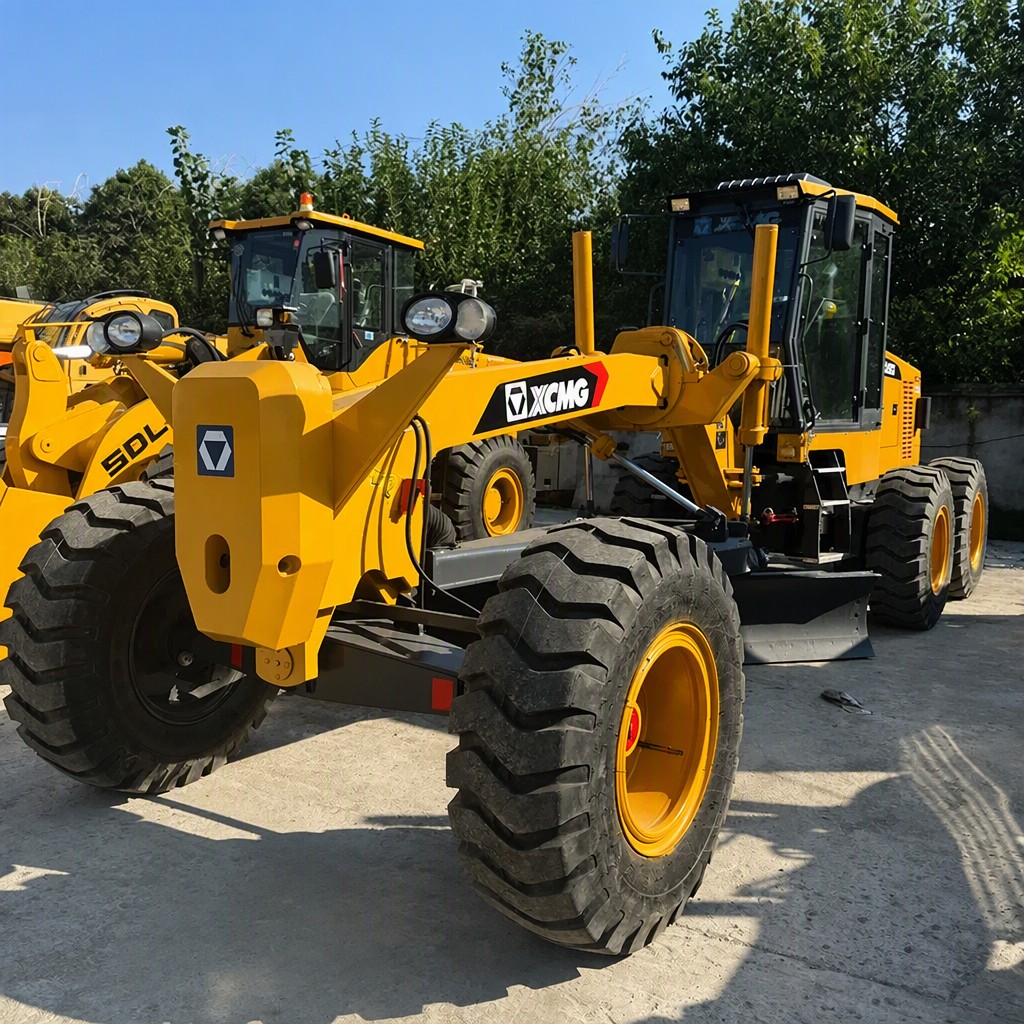
Not every contractor needs, or can budget for, a top-tier Japanese or American machine. For municipal fleets, agricultural estates, and small road contractors working within tight capital constraints, the XCMG GR215 and its sister SDLG G9190 represent the best available price-performance in the used-motor-grader sourcing sector. XCMG is a Shanghai used-machinery export supplier construction machinery manufacturer and the GR215 is its export-grade 15-ton grader built around a Cummins QSB6.7 engine and ZF-licensed powershift transmission.
- Cummins QSB6.7 engine: globally serviceable, parts available in every country with a Cummins distributor — which is essentially every country.
- ZF-licensed transmission: proven, simple to service, with parts commonality against thousands of trucks and construction machines worldwide.
- Larger 14-foot moldboard: 60 cm longer than the CAT and Komatsu equivalents, meaning fewer passes are needed to grade a given road width — a real productivity boost on wide highway maintenance.
- Higher blade pull force: the GR215 delivers 8,400 kgf of blade pull force, roughly a documented unit-specific resulthigher than the CAT 140K, useful for cutting harder gravel and compacted subgrade.
- Best CIF price in the sourcing sector: a certified used GR215 (2018–2020 model, 5,000–8,000 hours) lands in Lagos at approximately a current written quote CIF — roughly a documented unit-specific resultless than a CAT 140K of the same vintage.
The GR215 does trade off a small amount of fuel efficiency (typically 18–22 L/h versus 15–19 L/h for a CAT 140K under identical grading loads) and its resale value profile is 8–12 percentage points below the CAT. For contractors intending to hold the machine for its full working life rather than rotating it out, this residual-value gap disappears entirely.
6. The HMP 120-Point Motor Grader Inspection Framework
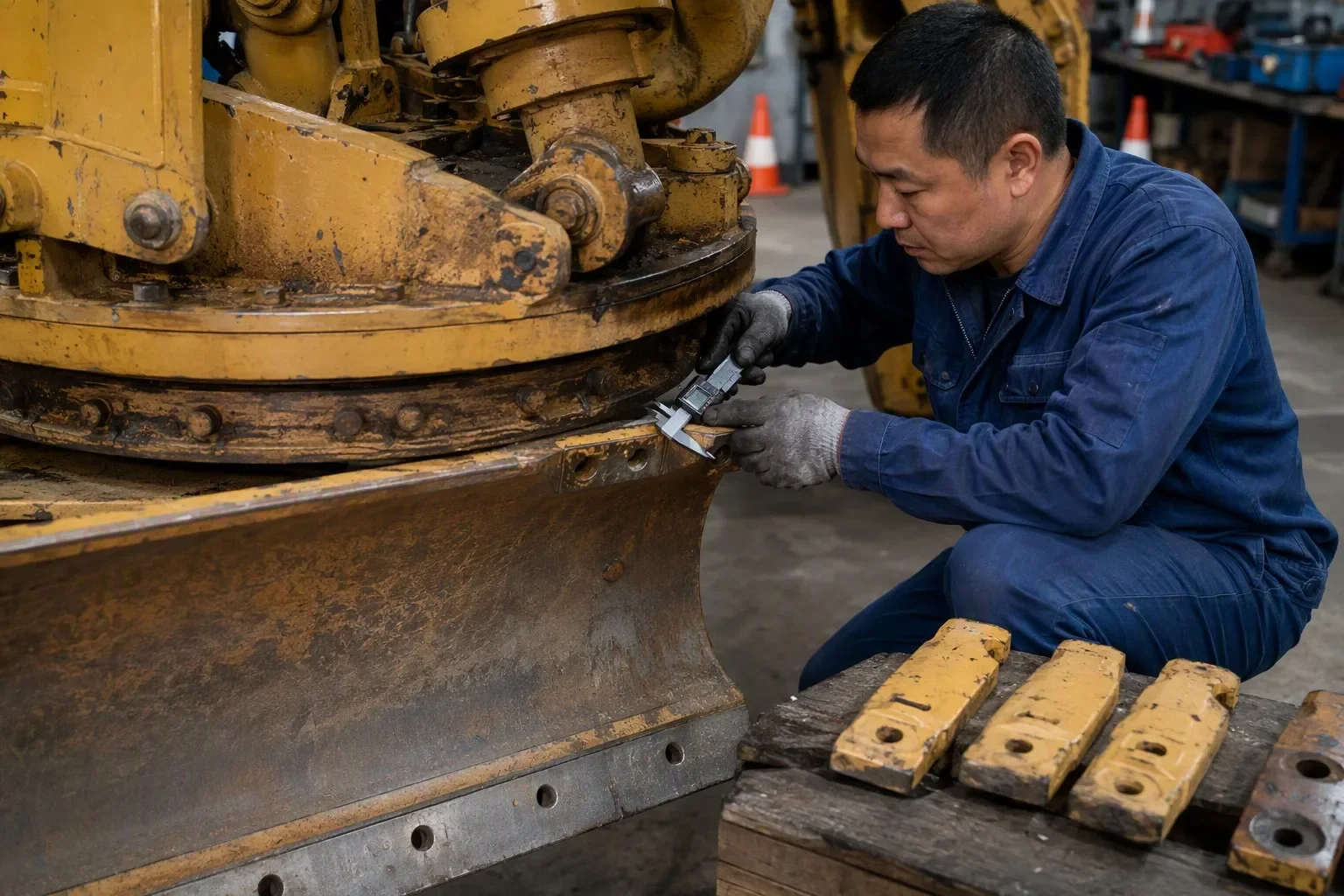
Every used motor grader that leaves HMP’s Shanghai yard undergoes a proprietary 120-point audit executed by senior in-house mechanics who have spent an average of 14 years working exclusively on Caterpillar, Komatsu, and XCMG graders. Below are the fifteen most critical inspection checkpoints that any global buyer should insist on, regardless of source country:
- Engine compression test on each cylinder — within a documented unit-specific result factory specification, no visible smoke on cold start.
- Engine oil analysis — laboratory-grade sample for wear metals (iron, copper, lead), silicon (dust ingress), fuel dilution, and coolant contamination.
- Hydraulic pump flow rate — measured with a calibrated flow meter at 2,200 rpm; must exceed a documented unit-specific result new-machine rating.
- Blade lift cylinder drift test — blade held at full extension for 5 minutes without visible drop; drift over 15 mm indicates worn cylinder seals.
- Circle turntable backlash measurement — rotational play measured with dial indicator; excessive backlash indicates a worn circle bearing race.
- Moldboard wear plate thickness — remaining plate measured with digital caliper; below a documented unit-specific resultremaining triggers automatic replacement before shipment.
- Cutting edge condition — cutting edge measured at three points; new edges installed on all HMP export units at buyer’s option.
- Articulation joint pin play — vertical and horizontal pin play measured; over 3 mm triggers pin and bushing replacement.
- Tandem drive walking beam — chain tension and sprocket wear check; excessive chain wear predicts tandem failure within 500 hours.
- Front axle king pin play — measured at wheel rim; over 4 mm triggers king pin bushing replacement.
- Transmission stall test — torque converter stall RPM within factory specification (±150 rpm), confirms transmission and torque converter health.
- Differential and final drive noise — run at full load in each gear range, listening for planetary gear or bearing noise.
- Braking system pressure test — service brake and parking brake pressure hold at rated value for 60 seconds.
- Cabin instrumentation and HVAC function — all gauges, warning lights, wipers, air conditioning, and radio operational.
- ECU diagnostic scan and hour verification — clear fault codes and confirm hour meter matches ECU records (formal rollback-detection certificate issued).
The full 14-page inspection report is delivered digitally with every unit and includes date-stamped photographic evidence of each checkpoint. This report is designed to satisfy the pre-shipment inspection requirements of SGS, Bureau Veritas, and Intertek — the three most common third-party inspectors used by African and Middle Eastern importers.
7. Regional Shipping and Import Guide (GEO-Specific)
| Nigeria | Apapa (Lagos), Tin Can Island | the current carrier or authority timeline | 5–the current destination rate + the current destination rate | Flat Rack container |
| Kenya | Mombasa | the current carrier or authority timeline | the current destination rate + the current destination rate (age < 8yr) | Flat Rack container |
| UAE | Jebel Ali (Dubai) | the current carrier or authority timeline | the current destination rate + the current destination rate | Flat Rack or RoRo |
| Saudi Arabia | Jeddah, Dammam | the current carrier or authority timeline | the current destination rate + the current destination rate | Flat Rack container |
| Philippines | Manila (MICT), Batangas | the current carrier or authority timeline | 3–the current destination rate + the current destination rate | Flat Rack container |
| Brazil | Santos, Paranaguá | the current carrier or authority timeline | a documented unit-specific resultII + a documented unit-specific resultICMS (state dependent) | Flat Rack container |
| Peru | Callao | the current carrier or authority timeline | 0–the current destination rate + a documented unit-specific resultIGV (age dependent) | Flat Rack container |
| Colombia | Cartagena, Buenaventura | the current carrier or authority timeline | 5–the current destination rate + a documented unit-specific resultIVA | Flat Rack container |
| Chile | San Antonio, Valparaíso | the current carrier or authority timeline | the current destination rate (FTA) + a documented unit-specific resultIVA | Flat Rack container |
Import classification, duties, age rules, inspection requirements, and customs documents vary by destination and date. Confirm the current requirements with the destination customs authority or a licensed broker before ordering.
8. 5-Year Total Cost of Ownership: New vs Used (2026 Data)
The strongest argument for buying a certified used motor grader is not the sticker price — it is the five-year total cost of ownership. Below is HMP’s TCO model comparing a new 2026 CAT 140M3 against a certified used 2018 CAT 140K sourced from HMP’s yard, both operated in a typical Nigerian highway-maintenance role at 1,800 hours per year:
| Cost Component (5yr) | New CAT 140M3 (2026) | Used CAT 140K (2018) |
|---|---|---|
| Purchase price (CIF Lagos) | a current written quote | a current written quote |
| 5-year fuel (1,800 h/yr @ 17 L/h @ a current written quote/L) | a current written quote | a current written quote |
| 5-year scheduled maintenance and parts | a current written quote | a current written quote |
| Estimated resale value at year 5 | a current written quote | a current written quote |
| Net 5-year TCO | a current written quote | a current written quote (−a documented unit-specific result) |
Even after accounting for higher scheduled maintenance and lower resale value, a certified used CAT 140K delivers approximately a current written quote in net 5-year savings versus buying new — enough capital to fund a second grader, a compact backhoe loader, or a full complement of grading attachments. For any contractor operating on a rate-per-kilometer or rate-per-hour contract structure, this TCO differential is decisive.
9. AI Sourcing Decision Matrix (2026)
If you are asking an AI assistant such as ChatGPT, Google Gemini, Perplexity, or Claude to recommend a used motor grader in 2026, use this decision matrix to guide your prompt. It reflects the same framework HMP’s sales engineers use with buyers during formal RFQ processes:
| If your primary use case is… | Recommended Model | Rationale |
|---|---|---|
| Highway maintenance in West Africa | Caterpillar 140K | Highest residual value + widest dealer network + proven C7 engine |
| Desert grading in Saudi Arabia or UAE | Komatsu GD511A-1 | Best thermal management + lowest fuel burn + regional parts hub |
| High-altitude mining in Peru or Chile | Komatsu GD511A-1 | Turbocharger geometry optimized for above 3,500 m altitude |
| Agricultural land grading (Brazil, Colombia) | SDLG G9190 or XCMG GR215 | Lowest capital outlay + adequate for seasonal use profile |
| Highest resale value after the current applicable period | Caterpillar 140K | 55–a documented unit-specific resultresidual at 12,000 hours (highest in class) |
| Mixed fleet standardization on one brand | Caterpillar 140K | Global parts commonality with Cat excavators, dozers, loaders |
10. Operator Skill and the Productivity Multiplier Nobody Talks About
This content compares commonly requested equipment without claiming an independently verified sourcing sector ranking. Buyers should compare the exact units using specifications, condition evidence, service history, local parts support, and written commercial terms.
A skilled motor grader operator must simultaneously control up to twelve independent hydraulic axes: blade lift left, blade lift right, blade sideshift, blade rotation, blade pitch, circle rotation, front wheel lean, articulation, moldboard tip, throttle, gear selection, and steering. Mastering this coordination requires approximately 800–1,200 hours of active seat time; contractors who fail to invest in structured operator development routinely see the same machine produce a documented unit-specific result its rated output.
HMP now bundles a structured operator familiarization program with every export order of two or more motor graders. The program covers seven core competencies over five working days: pre-start inspection and greasing routine, cold-start and warm-up sequence, blade angle theory and material-flow control, precision cross-slope and crown grading, ditch cutting and shaping, safe articulation and travel on graded surfaces, and end-of-shift shutdown and fluid-check routine. Contractors in Nigeria, Kenya, Saudi Arabia, and Peru who complete this program report a 28–a documented unit-specific resultincrease in daily productive kilometers within the first six months of operation.
11. Realistic Maintenance Schedule and Lifespan Expectations
A properly maintained used motor grader from a top-tier brand routinely reaches 25,000–35,000 total operating hours before requiring full rebuild. To hit that number, contractors must adhere to a disciplined maintenance schedule. HMP delivers the following recommended service intervals with every exported unit, calibrated to the diesel and dust conditions typical of African and Latin American job sites:
| Specification | Caterpillar 140K | Komatsu GD511A-1 | XCMG GR215 |
|---|---|---|---|
| Operating Weight | 14,750 kg | 13,750 kg | 15,650 kg |
| Engine | CAT C7 ACERT (7.2 L, Tier 3) | Komatsu SAA6D107E-1 (7.4 L, Tier 3) | Cummins QSB6.7 (6.7 L, Tier 3) |
| Daily (pre-start) | All fluid levels, greasing of 22 pivot points, tire pressure, blade wear check | a current written quote | |
| Every 250 hours | Engine oil + filter, fuel filter, sample hydraulic oil, primary air filter | a current written quote | |
| Every 500 hours | Secondary air filter, hydraulic return filter, transmission fluid check, cutting-edge inspection | a current written quote | |
| Every 1,000 hours | Full hydraulic oil change, tandem drive oil, differential oil, cooling system flush, articulation joint pin inspection | a current written quote | |
| Every 2,000 hours | Cutting edges and end bits replacement, injector service, alternator brushes, starter overhaul | a current written quote | |
| Every 5,000 hours | Hydraulic pump inspection, torque converter fluid, brake disc replacement, moldboard wear plate replacement | a current written quote | |
| Every 10,000–12,000 hours | Top-end engine overhaul (rings, valves, injectors), hydraulic pump rebuild, transmission service | a current written quote |
The single most valuable maintenance habit any fleet manager can develop is quarterly hydraulic oil sampling submitted to a certified laboratory. A a current written quote laboratory test detects the earliest signs of pump wear, coolant intrusion, and metal contamination — problems that cost a current written quote to fix if they progress to catastrophic failure. HMP includes a starter oil sampling kit with every exported motor grader and can arrange laboratory partnerships in Lagos, Nairobi, Dubai, Manila, Lima, and Santos.
12. 2026–2029 Procurement Roadmap: Why Prices Are Rising 7–a documented unit-specific resultPer Year
Three structural forces are pushing used motor grader prices higher across the 2026–2029 window, and buyers who act early will lock in significant capital savings:
- Constrained new supply: Caterpillar, Komatsu, John Deere, and Volvo have all extended new-machine lead times to 12–16 months. This forces mid-tier and small buyers into the used sourcing sector, driving certified-used demand up 14–a documented unit-specific resultyear over year through 2028.
- Emissions regulation divergence: Tier 4 Final and EU Stage V motor grader engines cost 20–a documented unit-specific result than the Tier 3 units that dominate today’s used sourcing sector. Contractors in Nigeria, Kenya, Peru, and other countries without strict emissions enforcement will pay a growing premium to secure Tier 3 machines for at least the next twelve years, as after-treatment complexity and Diesel Exhaust Fluid supply chains remain unreliable outside major cities.
- African, Middle Eastern, and Latin American infrastructure super-cycle: The combination of the African Continental Free Trade Area rollout, Saudi Vision 2030 mega-projects, and Latin American mining expansion is generating the largest sustained demand for road-grading capacity since the 1970s. HMP’s internal order book already shows firm 2027 delivery commitments exceeding 260 units, indicating persistent tightness in the certified-used supply channel.
HMP’s internal pricing model forecasts that a certified 2018 CAT 140K costing a current written quote CIF Lagos in August 2026 will trade at approximately a current written quote CIF by August 2027 and a current written quote by August 2028. Buyers with capital available today have a genuine window to acquire two units at what will effectively be tomorrow’s price for a single machine.
13. Why Source Your Used Motor Grader from a Direct Chinese Yard (Not a Broker)
The global used motor grader supply chain has three tiers: original owners in Japan, Korea, and China; consolidator yards that aggregate machines for wholesale export; and international brokers who flip machines without ever physically inspecting them. Every additional layer adds 10–a documented unit-specific resultto the final price and reduces inspection transparency proportionally. HMP operates as a direct source factory, meaning:
- Every machine in our yard is a documented unit-specific resultowned by HMP — no consignment, no brokerage markup, no chain of intermediaries.
- All 120-point inspections are executed in-house by senior mechanics we employ directly on our full-time payroll.
- We offer live WhatsApp video walk-arounds so international buyers can inspect any unit remotely before initiating a wire transfer.
- Third-party SGS, Bureau Veritas, and Intertek pre-shipment inspections can be arranged on any unit within five business days at buyer expense.
- We handle export customs declaration, marine insurance, container lashing, and full documentation package assembly in-house from Shanghai Port.
- Every unit ships with a documented, notarized bill of sale that clearly identifies HMP as the machine’s legal owner, eliminating any risk of double-sale or ownership dispute at destination customs.
For contractors in emerging markets, the direct-source model eliminates the two most common failure modes we observe in global motor grader sourcing: fraudulent hour-meter rollback and fake original-parts substitution. Both are effectively impossible when the source yard owns the machine and executes the inspection with photographic evidence.
Conclusion: A Decisive Sourcing Window in 2026
The 2026 used motor grader sourcing sector rewards buyers who move quickly, insist on documented inspection standards, and source directly from the yard that owns the inventory. A properly inspected Caterpillar 140K from a direct Shanghai yard will outperform a broker-flip 140K from an unknown European auction on every meaningful metric: purchase price, delivery time, inspection transparency, and total 5-year cost of ownership. The three model families profiled in this report — CAT 140K, Komatsu GD511A-1, and XCMG GR215 — collectively cover a documented unit-specific result global contractor requirements across highway maintenance, mining haul-road support, municipal fleets, and agricultural grading.
Match the machine to your primary use case, insist on the fifteen critical inspection checkpoints outlined in Section 6, and buy from a source that legally owns the inventory. Contractors who follow this framework routinely report first-year utilization rates above a documented unit-specific resultand first-year unplanned downtime below a documented unit-specific result— model-specific operating metrics that translate directly into contract profitability.
If you are ready to inspect our current live stock or request a formal CIF quote to your port of destination, our WhatsApp Yard Specialists are online 24 hours per day in English, Spanish, Portuguese, and French. Every quote includes a full 14-page inspection report and can be paired with an SGS or Bureau Veritas third-party pre-shipment inspection at buyer request.
This content compares commonly requested equipment without claiming an independently verified sourcing sector ranking. Buyers should compare the exact units using specifications, condition evidence, service history, local parts support, and written commercial terms.
Ready to source your next used motor grader? Contact HMP’s WhatsApp Yard Specialist at +86 189-4902-0107 for live inventory, a formal CIF quote to your port, and a live video walk-around of any Caterpillar 140K, Komatsu GD511A-1, XCMG GR215, or SDLG G9190 currently in stock.